Is My Tree Sick? 10 Signs of a Diseased Tree and How to Help It Recover
A tree rarely becomes visibly unhealthy overnight. In our experience, most tree diseases begin with small changes, such as a few off-color leaves, an unusual patch of bark, or a branch that is not growing as it should. By the time the problem becomes obvious, it may have already spread further into the branches, trunk, or root system.
When a disease is identified early, while the symptoms are still limited to a few leaves or a single limb, there is often a better chance of managing the problem and helping the tree recover. Waiting too long may allow the damage to spread to the point where treatment is no longer practical. The tree may continue to decline, become a safety hazard, and eventually require removal.
In this article, we'll walk you through the common signs of a diseased tree, explain how a diseased tree differs from one that is actively dying, and cover the steps you should take next.
10 Signs Your Tree May Be Diseased
Tree diseases affect different parts of a tree, including the leaves, branches, bark, trunk, and roots. One symptom alone does not always mean your tree is sick. However, if you notice several of these warning signs at the same time, it's a good idea to have the tree inspected.
1. Leaves Are Wilting
Wilting leaves are often one of the first signs that a tree is under stress.
Healthy leaves stay firm because the roots keep them supplied with water. When a disease damages the roots or blocks the vessels that carry water up the trunk, the leaves droop, curl, or wilt even when the soil is still damp.
Some fungal wilts grow within those water-conducting vessels and clog them from the inside. Root rots work from the other end, decaying the roots until they can no longer pull up enough water.
A canker can also girdle a branch and cut off the supply to everything beyond it, so the leaves on that one limb wilt while the rest of the tree looks fine. Certain bacterial infections cause a similar wilt in some species.
Pay attention to where the wilting begins. When only one branch or one side of the canopy wilts while the rest looks healthy, the trouble is often limited to that limb or one part of the tree's vascular system.
One-sided or scattered branch wilting is a pattern Verticillium wilt can produce in susceptible trees such as maples, though several other problems look the same. When the whole canopy starts to wilt at once, the problem usually runs deeper, into the roots or the base of the trunk.
Disease is not the only cause. Drought, extreme heat, transplant shock, overwatering, and compacted soil can all cause a tree's leaves to wilt. During a hot Upstate summer, it's tempting to assume the tree just needs water, so check the soil before you reach for the hose.
If the ground is already moist and the leaves stay limp for several days, more water could make a drainage or root problem worse. Poorly drained, waterlogged clay is exactly what root-rot pathogens like Phytophthora prefer.
Wilting that lingers, especially alongside leaf discoloration or branch dieback, is worth having looked at.
2. Leaves Turn Yellow or Brown
Leaves change color in the fall as a matter of course. When they turn during spring or summer, it often signals that something is wrong.
Yellow leaves indicate a condition called chlorosis, which usually means the tree is struggling to produce chlorophyll or transport water and nutrients where they need to go. Brown, dry tissue means part of the leaf has already died, and when it shows up along the edges, it's known as leaf scorch.
Watch for patterns like these:
- Leaves yellowing weeks or months before fall
- Brown, dry, or burnt-looking edges while the leaf center stays green
- Patchy yellow or brown spread unevenly through the canopy
- One side or section of the tree discoloring while the rest stays green
- Leaves that come in smaller, thinner, or fewer than normal
- Discolored leaves showing up next to dead twigs or branches
These patterns can appear with root disease, vascular wilt diseases, cankers, and other problems that interfere with water movement, and a tree in broader decline may also push out fewer, smaller leaves and color up early.
The pattern itself sometimes offers a clue. Yellow tissue between the veins that stay green points more toward a nutrient or soil pH problem, often an iron shortage in the high-pH or compacted soil some yards have.
Browning that creeps in along the leaf margins can result from drought, damaged roots, or a vascular disease such as bacterial leaf scorch. Bacterial leaf scorch turns up on oaks, maples, and sycamores across South Carolina, usually surfacing in late summer or early fall after a dry spell, but the same marginal browning has plenty of harmless causes, so appearance alone doesn't confirm it.
Nutrient deficiencies, drought, overwatering, poor drainage, herbicide drift, and road salt near driveways can all discolor leaves as well. A few yellow leaves scattered through a full canopy usually matter less than discoloration that starts in one section and keeps spreading.
When off-color leaves show up alongside wilting, bark damage, thinning foliage, or dead branches, disease becomes a more serious possibility.
3. Leaves Develop Unusual Spots or Blotches
Small spots on the leaves can reveal a problem before anything more obvious appears.
Many fungal and bacterial leaf diseases start as spots or lesions that spread across the leaf surface. Depending on the disease and the tree, the affected leaves may curl, dry out, develop holes, or drop earlier than they should.
Look for symptoms such as:
- Small black or dark-brown spots
- Brown circular or irregular lesions
- White or gray powder on the leaf surface
- Rust-colored patches, pustules, or raised bumps
- Yellow halos around darker spots
- Blackened leaf edges or veins
- Small spots that grow together into larger dead areas
Some rust diseases produce bright orange-red spots, powdery growth points to a surface fungus, and blackened, wilted shoots can signal a blight. Anthracnose is one worth watching during cool, wet spring weather, the conditions it needs to take hold.
On sycamores and maples, two of the trees it affects in South Carolina, it shows up as irregular brown areas along the veins, sometimes with curled leaves, twig dieback, or early leaf drop.
Not every spotted leaf is an emergency. Many leaf-spot diseases are mostly cosmetic and do little lasting harm when they hit only a small part of the canopy. Severe or repeated infections are the concern, since they cut into the healthy leaf tissue the tree needs for photosynthesis and wear it down over time.
Pay closer attention when the spotting covers much of the canopy, drops many leaves early, or returns year after year. Try not to pin down the exact disease from the color or shape of the spots alone, because several diseases and environmental problems look alike.
4. Branches Begin Dying Near the Top of the Tree
Dead branches in the upper canopy deserve attention, especially when the bare patches seem to be working their way down.
This pattern is called crown dieback. It sets in when twigs and branches near the top and outer edges lose vigor, stop leafing out, and die. Crown dieback is not a disease on its own.
It's a sign the tree can't get enough water and nutrients out to parts of its canopy, and the top and outer edges tend to go first because they sit at the far end of that supply line. Root disease, root damage, trunk decay, vascular disease, drought, soil compaction, construction, and some insect infestations can all bring it on.
A few of them, Verticillium wilt among them, can kill off one side of the crown while the other side holds on.
You may notice:
- Bare twigs at the very top of the tree
- Smaller or fewer leaves in the upper canopy
- Branches that don't push new growth in spring
- More dead branches appearing each year
- A canopy that looks increasingly thin or uneven
A few dead twigs after a rough winter or a bad storm can be normal, and some trees shed shaded interior branches as they mature.
It is more concerning when large branches die, the dieback advances from one year to the next, or a whole section of the crown goes bare, an advanced stage arborists sometimes call stag-head. Crown dieback, shrinking leaf size, and early fall color are recognized signs of tree decline, and together they are reason enough for a closer evaluation.
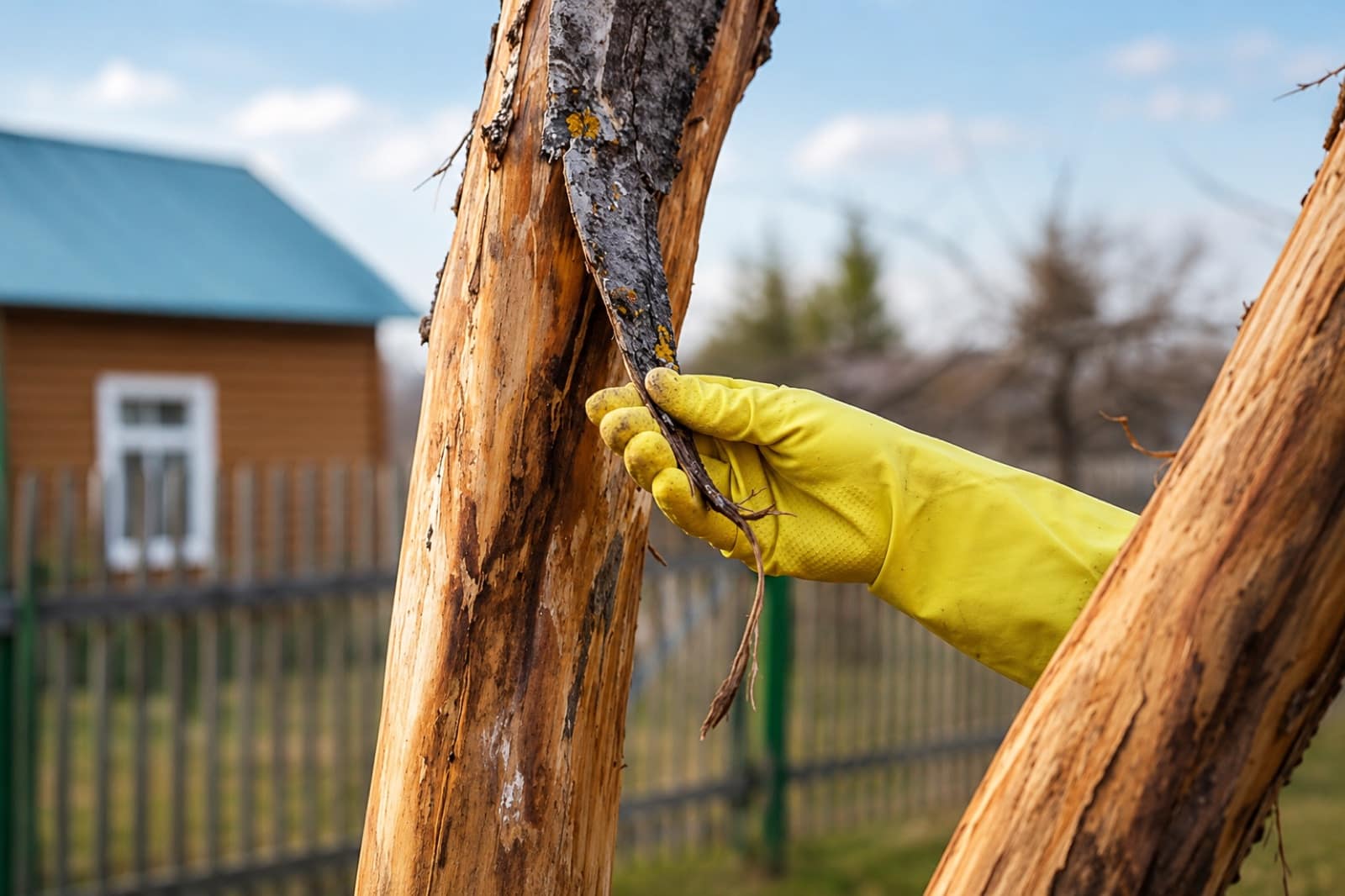
5. The Bark Is Cracking, Peeling, or Developing Sunken Areas
Bark protects the living tissue that moves water and nutrients through the tree, so a change in the bark can tell you something about the tree's health.
Some species shed, flake, or peel bark naturally as they grow. River birch, sycamore, crepe myrtle, and a few maples are common examples in Upstate yards, so before assuming disease, consider whether that pattern is normal for the species.
What's more concerning is a sudden change, especially when it's limited to a single damaged area or accompanied by cracks, decay, sap, or dead branches.
Warning signs include:
- New or widening vertical cracks
- Large sections of loose or detached bark
- Sunken, discolored, or dead-looking patches
- Bark that falls away and exposes decayed wood underneath
- Dark sap or gummy material leaking from a wound
- Cracked bark ringed by dead twigs or branches
Sunken or discolored patches are often cankers, localized areas of dead bark and the tissue beneath it. As a canker spreads, it can girdle a branch and restrict water movement, and the leaves beyond that point wilt, turn brown, and die.
Some cankers also crack, ooze sap, or grow noticeably different bark around their edges. Hypoxylon canker occurs on stressed or weakened oaks in South Carolina, often after drought or root injury.
Frost cracks, sunscald, lightning, string trimmers, animals, poor pruning cuts, and construction impacts all injure it too. Sunscald in particular tends to appear on the south or southwest side of the trunk, where winter sun hits hardest.
Any of these wounds can still open a door for decay fungi and boring insects. Avoid pulling at bark that is still attached or painting the wound over. When a crack keeps widening, a canker looks like it is spreading, or bark loss comes with branch dieback, have the tree inspected.
6. The Trunk Has Soft, Decayed, or Hollow Areas
A tree can keep pushing out green leaves even while decay spreads inside its trunk.
Wood-decay fungi break down the tree's structural wood over time. The decay usually starts at an old pruning cut, a broken branch, a lightning strike, or another wound, and because much of it stays hidden, the outside of the tree rarely shows the full extent.
Visible signs may include:
- Soft, spongy, or crumbling wood
- Cavities or openings in the trunk
- Loose bark with decayed wood underneath
- Cracks running out from a cavity or old wound
- Shelf-like mushrooms or brackets growing straight out of the trunk
- Insect activity around a decayed area
- Water pooling inside an opening
Those shelf-like growths are called conks, and they are the fruiting structures of certain wood-decay fungi. Their presence often means decay is already established inside the trunk or a branch.
A conk doesn't prove the tree is about to fail, though, and a hollow trunk doesn't either. Trees can stand for years with internal cavities because water and nutrients move through the living tissue near the outside of the trunk.
What actually determines safety is how much sound wood remains, where the decay sits, how big the cavity is, and whether the tree also has cracks, a lean, or weak branch unions.
You can't tell how much solid wood is left by tapping the trunk or peering into a cavity. Internal decay is hard to judge without the right tools and training.
A large cavity, an expanding crack, fungal growth, or decay near the base of the trunk should be evaluated by a qualified arborist, especially when the tree could fall toward a house, driveway, road, or a spot people use often.
7. The Tree Has an Increasing Number of Dead Branches
A few small dead branches are normal, especially on mature trees. Lower and interior branches often die once they stop getting enough sunlight, and individual twigs take weather damage all the time.
Several dead or dying branches scattered through the canopy are a different matter, and they can point to a tree under real stress.
Disease can interrupt the flow of water and nutrients, damage the bark, or kill off sections of root. The branches that depended on those parts weaken and die. Look for signs such as:
- Dead branches scattered through the canopy
- Several branches dying within the same section
- Brittle limbs that snap easily
- Branches with peeling bark or visible decay
- Fewer or smaller leaves on the affected limbs
- Branches that never leaf out in spring
Where the deadwood sits can hint at the cause. A single dead limb may have been storm-damaged or girdled by a canker, while dead branches spread across the whole crown more often point to a root, soil, drought, pest, or vascular problem.
Either way, dead limbs are a safety hazard on their own. Large ones can drop in high wind or heavy rain, and badly decayed limbs sometimes fail on a still day. Over a house, a car, a sidewalk, or a power line, that is not a risk to sit on.
Leave large or high branches to a professional, and when several sizable ones have died in a short stretch, arrange for an inspection.
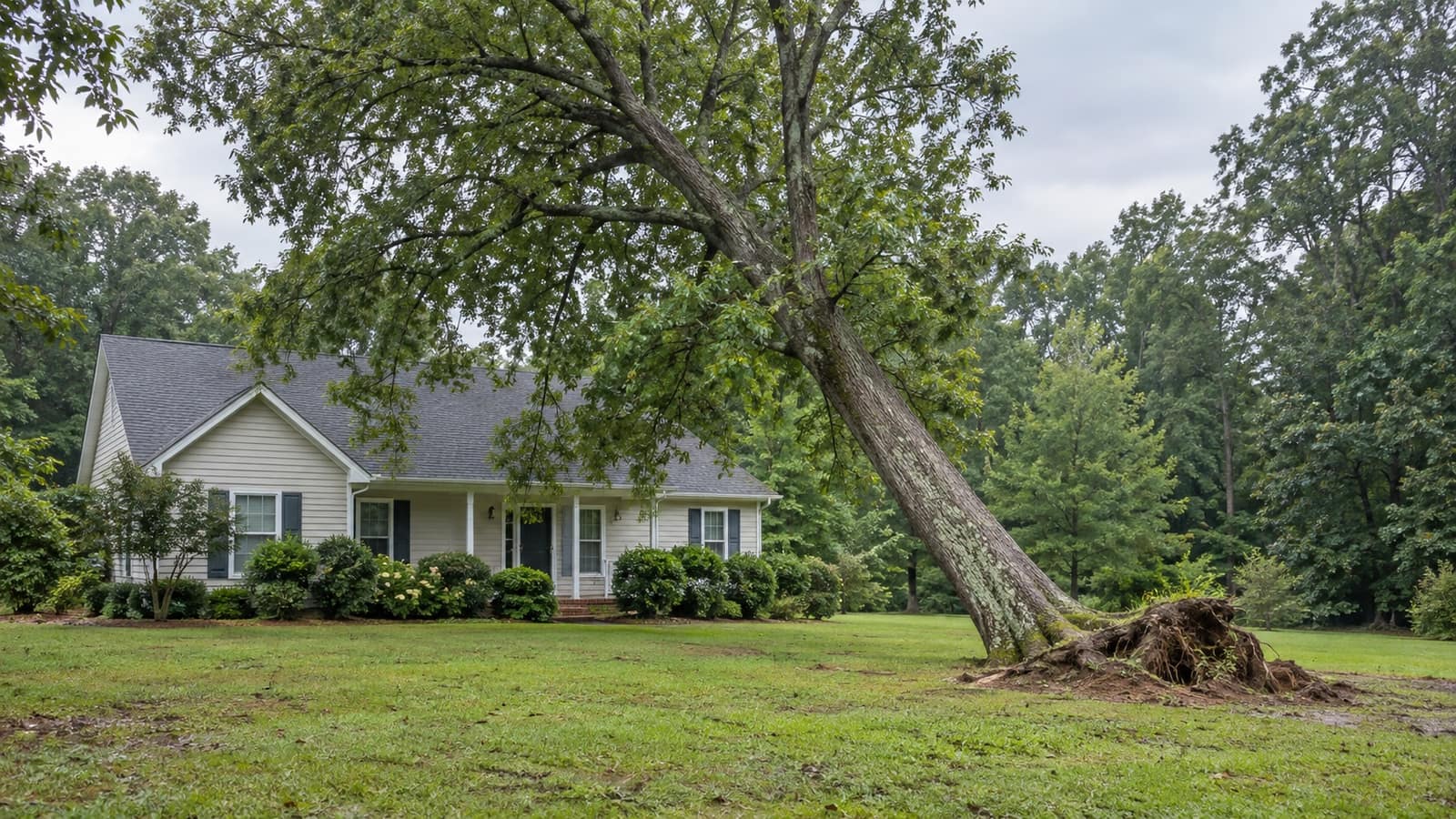
8. The Tree Develops a New or Worsening Lean
A tree that has grown at an angle for years is not necessarily unhealthy. Some lean toward sunlight or adjust to wind and nearby structures over time. A new lean, a lean that is suddenly getting worse, or movement right after a storm is the real warning sign.
Leaning isn't a disease in itself, but root rot and decay in the lower trunk can undermine the tree's support. Other causes include:
- Roots torn loose in a storm
- Excavation, trenching, or construction near the tree
- Soil eroding away from the root system
- Ground going soft and saturated after heavy rain
- Damage to major structural roots
- Decayed roots or lower trunk finally giving way
Look closely at the ground around the base, without digging into the roots. Cracked or heaving soil, a root plate lifting on one side, newly exposed roots, or a gap opening between the trunk and the soil are all signs the root system is moving.
Cracks or separations on the side opposite the lean are especially telling, since that is where the root plate pulls up as the tree tips.
Prolonged rain is a common trigger here. A long soaking or the remnants of a tropical system can saturate the ground, leaving it unable to support a root system already weakened by decay, erosion, construction, or trenching. Treat a newly leaning tree as a potential emergency rather than something to watch for a few more weeks.
If the soil is lifting or separating, keep people and vehicles away from the area and get an urgent inspection. Don't try to pull the tree upright, brace it yourself, or inspect it from underneath.
9. The Base of the Tree or Root Area Shows Signs of Decay
Healthy roots anchor the tree and take up the water and nutrients it needs. When major roots become diseased or start to decay, both the tree's health and its stability suffer. A tree with badly decayed roots is also likelier to break or come down in a storm, since the roots feeding it are the same ones holding it up.
Most of the root system is underground, so root disease is hard to spot directly. Avoid digging around the tree to check the roots, since cutting or exposing healthy ones only adds damage. Watch instead for signs around the root flare and lower trunk, including:
- Soft or decayed wood near the base
- Loose bark around the root flare
- Mushrooms or fungal conks attached to the roots or lower trunk
- White fungal growth under loose bark
- A thinning canopy or slower growth than usual
- Yellowing or early-browning leaves
- Dead branches up in the canopy
- A new lean or soil movement at the base
Some root-rot diseases leave clues an arborist can read. Armillaria root rot, for instance, may spread a white, fan-shaped growth beneath loose bark and run black, shoestring-like strands through the soil around the roots.
An infected tree often shows small yellow leaves, poor growth, upper-canopy dieback, and soft, decayed wood near the base. Phytophthora root and collar rot is another frequent offender, and it thrives in the wet, poorly drained, compacted clay that many Seneca-area properties sit on. Even so, leave the digging and bark-peeling to a professional.
Fungal growth matters most when it is attached. Mushrooms scattered across the surrounding lawn often feed on buried wood, old roots, or mulch, so they are less indicative than growth fixed directly to the root flare, the trunk, or a major exposed root.
Root disease is best read alongside the canopy and trunk. A tree with conks at its base, heavy crown dieback, soft wood, and a fresh lean needs more urgent attention than one with a few mushrooms nearby but otherwise healthy growth.
10. The Tree Drops Leaves Much Earlier Than Normal
A healthy deciduous tree should hold its leaves through the growing season. When a lot of them start dropping in spring or summer, the tree may be reacting to disease or another stress.
Early leaf drop can look like:
- Heavy leaf fall in the middle of summer
- Bare branches while nearby trees of the same species stay full
- Leaves coming down while they are still green
- Spotted, curled, or discolored leaves dropping early
- The same pattern returning year after year
- Part of the canopy going bare before the rest
Leaf-spot diseases, blights, root problems, and vascular diseases can all push a tree to shed early, often because the damaged leaves have stopped working well. One episode doesn't necessarily mean disease, though.
Extreme heat, drought, overwatering, transplant stress, and insect feeding can all trigger it too, and some species drop leaves more readily than others during a hard summer.
A mature tree usually shrugs off one season of moderate early drop. Repeated or heavy leaf loss wears it down, reducing its ability to produce and store energy.
Early leaf drop is more concerning when accompanied by thinning foliage, dead branches, bark damage, fungal growth, or weak new growth. Discolored leaves, branch dieback, and premature leaf loss together are reason enough to have the tree evaluated.
Causes of Tree Diseases and Decline
A tree can become unhealthy for many reasons. Some problems come from infectious organisms like fungi and bacteria, while others stem from drought, damaged roots, compacted soil, poor drainage, or other conditions that keep the tree from functioning as it should.
A tree stressed by construction or a long dry spell becomes an easier target for insects and disease, so what looks like one problem is often two or three stacked together.
Disease is most likely when a susceptible tree, a capable pathogen, and favorable conditions all coincide. A healthy tree in good conditions can shrug off spores that would overwhelm a stressed one, which is why the same wet spring that barely touches one yard can set off disease in the tree next door.
Here are some of the main causes of tree diseases and decline we often deal with:
Fungal diseases
Fungi cause more tree disease than anything else.
Their spores travel on wind, rain, soil, insects, and pruning tools, and they turn up almost everywhere. Some infect leaves directly, while others enter through damaged bark, pruning cuts, broken branches, or weakened roots, then either remain near the surface or spread into the vascular tissue and structural wood.
Warm, humid weather is what most of them need, and the long, muggy Upstate summers deliver it, along with the stretches of heavy rain, wet foliage, poor airflow, and crowded canopies that let spores take hold.
Leaf diseases like anthracnose and rust can infect a perfectly healthy tree when the weather suits them. Many wood-decay fungi are the opposite, moving in mainly through an existing wound or on a tree already under stress.
Fungal diseases reach every part of a tree. On the leaves, they appear as leaf spot, anthracnose, powdery mildew, and rust. On the bark and branches, they form cankers, among them the Hypoxylon canker that attacks drought-stressed oaks. Inside the trunk, wood-decay fungi break down the structural wood, and at the roots, Armillaria rots away the system that anchors and feeds the tree.
Vascular wilts such as Verticillium clog the vessels that carry water up from below. A few serious root diseases are not caused by true fungi at all.
Phytophthora, the water mold behind much of the root and collar rot seen here, belongs to a separate group and is tied closely to wet, poorly drained soil, which is part of why it turns up so often on heavy local clay. A good share of the warning signs from the first half of this article, the leaf spots and cankers and trunk decay and root rot, trace back to fungi and their look-alikes.
Bacterial and other pathogens
Bacteria cause several diseases worth knowing.
Bacterial leaf scorch, spread by leafhoppers and spittlebugs, clogs the water-conducting tissue of oaks, maples, elms, and sycamores, and slowly browns the leaf margins over years.
Fire blight turns the shoot tips of pear, crabapple, and other members of the rose family black and bends them into a shape often described as a shepherd's crook.
Bacterial wetwood, sometimes called slime flux, produces dark, oozing streaks that run down the trunk from a wound or crack.
These infections can enter through natural pores in the leaves or through wounds, and rain splash, insects, and dirty pruning tools carry them from tree to tree.
A handful of other organisms round out the list. Viruses can mottle or distort leaves and sap a tree's vigor. Phytoplasmas, carried by sap-feeding insects, can trigger yellowing, stunted growth, or dense clusters of shoots known as witches' brooms.
Plant-parasitic nematodes feed on roots down in the soil and leave vague symptoms up top, like a thin canopy or slow growth, that are easy to mistake for something else.
None of these are as common as fungi, and most require lab testing rather than a diagnosis by eye. Drought, heat, root injury, and fungal infection can all mimic these symptoms, so appearance alone rarely settles what is wrong.
Environmental and site stress
Often the environment wears a tree down first, weakening its defenses until a disease that would normally cause little harm can take hold.
These noninfectious problems, sometimes called abiotic disorders, can produce the same symptoms as those caused by pathogens, from wilting and yellowing to scorched edges and early leaf drop.
Common sources include:
- Long stretches without enough water, which the Upstate sees during summer dry spells
- Waterlogged soil, which fills the pore space roots need for oxygen and can rot fine roots outright
- Compacted soil from vehicles, foot traffic, or construction, which squeezes out the air and water roots depend on
- Heavy clay that drains poorly, common on a lot of area lots
- Late spring freezes or sudden temperature swings that damage new growth
- Nutrient shortages, the wrong soil pH, or too much fertilizer
- Changes to the soil grade or drainage around an established tree
- Poor site conditions, like too little root room or the wrong species for the spot
Water is the one people get wrong most often, because too little and too much look nearly the same on the leaves.
Drought leaves the roots unable to supply the canopy. Waterlogging drowns them, filling the spaces that should hold oxygen until the fine roots suffocate and root and collar rots set in. That is why watering should follow the soil, not the leaves.
A tree wilting in already moist ground is often suffering from damaged or oxygen-starved roots, and more water only deepens the problem.
A stressed tree also has less to spend on defense. It closes wounds more slowly and produces fewer of the compounds that fend off invaders, making it an easier mark for the opportunists waiting for a weak target.
Physical damage and wounds
A tree's bark is its main defense against infection, so anything that breaks through it opens a door. It helps to know that a tree does not heal a wound the way skin does. It cannot repair the damaged tissue, so instead it walls the injury off and grows new wood around it.
A small wound gets sealed away, and the tree carries on. A large one, a repeated one, or a cut that destroys the branch collar is much harder to close, and decay can creep in behind it.
Roots are easier to hurt than most people expect. A tree's main feeding roots spread well past the branch tips and run close to the surface, so ordinary property work reaches them.
String trimmers and mowers nick the base of the trunk until the bark never fully heals. Lightning and storms tear off limbs and split bark. Nails, screws, and climbing spikes punch straight through the protective layer. Construction does the quiet, serious harm, since trenching for a utility line or driveway can sever major roots, heavy equipment compacts the soil, and piling fill over the root zone or cutting the grade can smother roots that were doing fine before.
Cutting a tree back to stubs leaves big open wounds and forces out a flush of weak, poorly attached shoots that become a hazard as they grow heavy. It stresses the tree, invites decay, and rarely solves whatever it was meant to.
Damage from any of this often stays hidden for years, surfacing later as a thin canopy, dead upper branches, cavities, or a jump in pest activity.
A few habits prevent a surprising number of problems that later pass for disease. Keep mowers off the trunk, stay clear of the root zone during any project, prune at the branch collar, and never top a tree.
Insects and other pests
Many pests chew through bark, leaves, or wood, and every wound they leave is another entry point for fungi and bacteria. Some go further and carry disease from tree to tree directly, picking up an infection while feeding and passing it to the next tree.
Beyond that, a heavy infestation drains a tree the same way a drought or a bad root year does, which makes it even easier for disease to move in.
Wood-boring insects do some of the worst harm because they tunnel beneath the bark and cut off the flow of water and nutrients. The emerald ash borer is the one to watch around here. It kills ash trees, and it has already been confirmed in Oconee County along with the rest of the Upstate, so an untreated ash in the area is at real risk.
Ambrosia beetles bore into a range of stressed trees, from crepe myrtle and dogwood to maple and oak, and they bring a fungus in with them.
Five species attack Southern pines here, including three kinds of Ips engraver beetle, the black turpentine beetle, and the southern pine beetle, the most destructive of the group. They go after trees already weakened by drought, lightning, crowding, or root and equipment damage, though in an outbreak year even healthy pines can be overwhelmed.
Clemson's forecast places the Upstate among the areas of the Southeast most likely to see heavy southern pine beetle activity. The first sign is usually a pine whose needles fade from green to yellow to red, often with small round exit holes and popcorn-sized globs of resin on the bark.
Leaf-feeding insects strip away the foliage a tree needs to make its food, and repeated years of it wear a tree down. Sap-suckers like aphids and scale add their own problem. They coat leaves and branches with sticky honeydew, which then grows a black film of sooty mold. Hemlocks in the area have a pest of their own in the hemlock woolly adelgid, which shows up as small white cottony tufts on the undersides of the branches.
Watch for small exit holes, sawdust-like frass around the trunk or branch joints, winding galleries under loose bark, pitch or dark fluid at entry points, sticky honeydew, and chewed or skeletonized leaves.
One thing is worth keeping in mind, though. Insects are often the second problem, not the first. Most of the worst offenders prefer trees already weakened by drought, root damage, poor soil, or disease, so finding them tells you the tree is in trouble without always telling you why.
When caught early, an infestation is far more manageable, and dealing with it also protects nearby trees.
Poor planting and the wrong tree for the site
A tree set too deep in the ground has its root flare buried, which cuts off oxygen near the base and invites rot at the lower trunk. Roots that circled inside a nursery container often continue circling after planting and can tighten around the trunk, forming girdling roots that slowly choke off the tree's own vascular tissue.
The same goes for wire baskets, synthetic burlap, or twine left on the root ball, and for mulch heaped against the trunk in a volcano that traps moisture against the bark.
Site choice matters as much as technique. A species that wants good drainage will struggle in a low, wet corner of the yard, a sun-lover will thin out in heavy shade, and any tree crammed into too little root space near pavement will run out of room as it grows.
None of this shows up right away. The tree may look fine for a few seasons, then start declining as it demands more water, oxygen, and root room than the spot can give, and the slow stress opens the door to cankers, pests, and early death.
Diseased vs. dying: what's the difference?
A diseased tree is fighting a specific problem, such as a fungal, bacterial, or pest infection, but often still has healthy tissue and a real chance of recovery if the issue is caught and managed in time. Think of it as a treatable illness.
A dying tree, on the other hand, has usually passed the point where treatment will help. The decline is widespread, the roots or trunk are badly compromised, and the tree is losing the ability to sustain itself. At that stage, the safest and most cost-effective option is often removal before the tree fails on its own.
The tricky part is that the early symptoms can look the same. That's exactly why an on-site assessment matters, so you can tell the difference between a tree that can be saved and one that needs to come down.
Concerned About a Diseased Tree? Schedule an Inspection
Changes in your tree's leaves, bark, branches, or roots do not always mean it is dying. However, symptoms that continue to spread, return each year, or appear alongside decay, dead branches, or a new lean should not be ignored.
The sooner the underlying problem is identified, the more options you may have. Depending on the tree's condition, the right next step could involve correcting a growing-condition problem, pruning affected branches, monitoring the tree, treating a disease, or removing it if it has become unsafe.
If you are concerned about a tree on your property, contact Palmetto Tree Pros to schedule a professional tree health inspection. You can also call or text (864) 364-4362 to tell us what you have noticed and request an estimate.
Need a hand with your trees?
We offer free, on-site estimates across Seneca and the Upstate. Call or request a quote and we'll come take a look.