How to Tell if a Tree Is Dying? Signs and What to Do
Tree decline rarely happens all at once. A tree may still produce leaves and look fairly normal while its roots, trunk, or branches are already struggling. The first changes can be easy to overlook, such as a thinner canopy, smaller leaves, bark that looks different, or branches that are not putting on as much new growth as they used to.
In the work we do, we have seen homeowners become concerned about a tree only after the signs are hard to ignore. A large branch may fall, the canopy may suddenly look sparse, or an entire section may stop producing leaves. But those bigger changes are often connected to problems that started months or even years earlier.
The tricky part is that not every change means a tree is dying. Drought, excessive rain, storm damage, insects, disease, and even normal seasonal changes can make an otherwise recoverable tree look unhealthy for a while. Looking at the whole tree, and at how its condition changes from one growing season to the next, usually tells you much more than a single dead branch or patch of brown leaves.
In this article, we'll walk you through the common signs a tree may be dying, how to check whether it is still alive, what can cause gradual decline, and how to determine whether the tree may recover or has become unsafe to keep.
How Can You Tell If a Tree Is Dying?
Start with the overall pattern rather than one symptom.
A few dead twigs, yellow leaves, or a mushroom in the lawn may tell you very little on their own. We become more concerned when several changes appear together or continue getting worse from year to year.
Take a step back and look at the entire tree. Ask yourself:
- Is the canopy thinner than it was a year or two ago?
- Are large branches dying rather than only small twigs?
- Is the tree producing less new growth?
- Are its leaves becoming smaller or dropping early?
- Are parts of the bark dying or falling away?
- Are there cavities, cracks, or decayed areas in the trunk?
- Is fungal growth coming directly from the trunk or root flare?
- Has the tree developed a new lean?
- Is the ground moving around the roots?
- Has anything around the tree changed in recent years?
That last question is easy to miss. Root damage from construction, trenching, grade changes, or soil compaction may not become obvious in the canopy immediately. Clemson Extension identifies root severing, changes in soil grade, and soil compaction as major reasons trees decline following construction, with the effects sometimes developing over the years that follow.
10 Signs a Tree May Be Dying
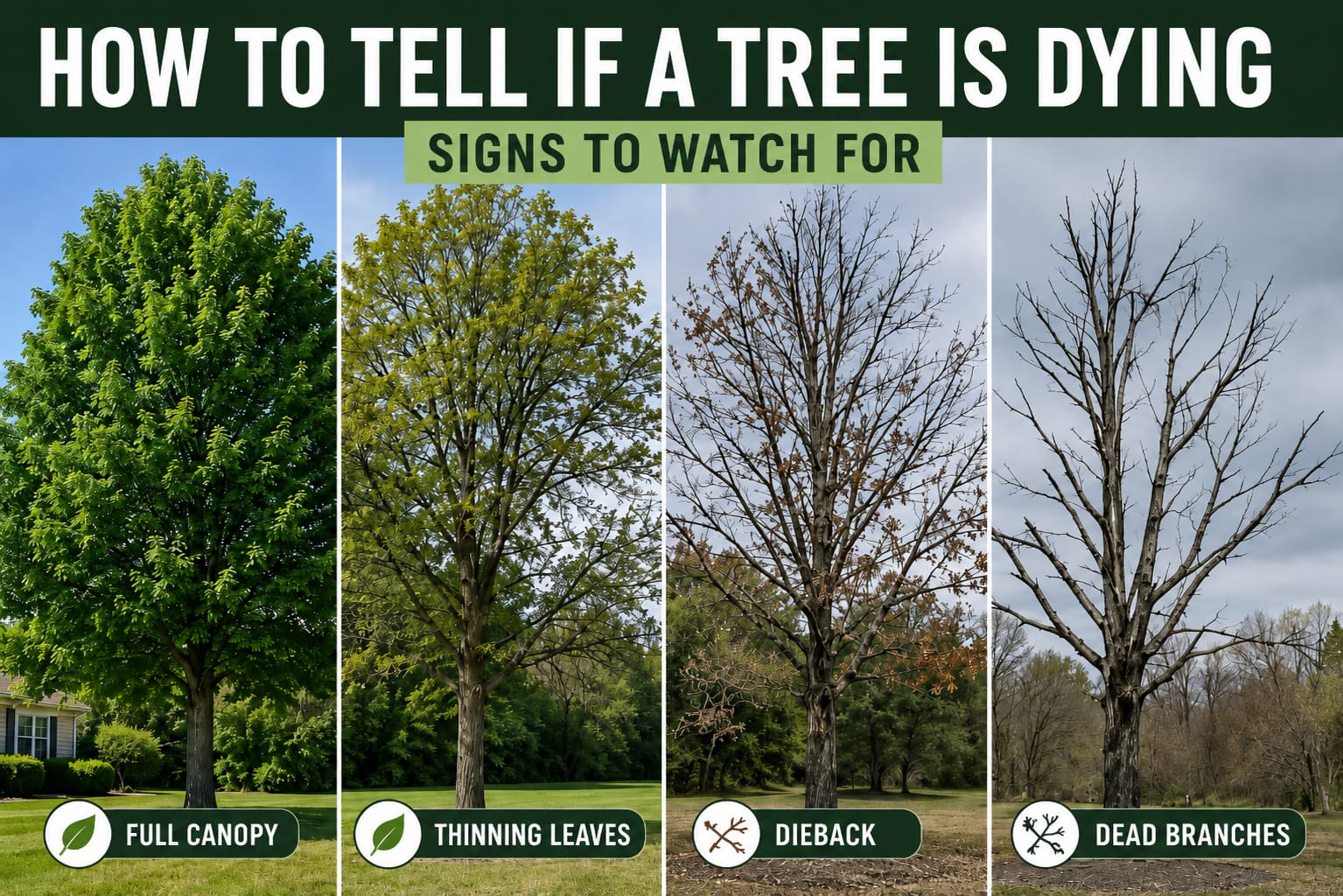
1. The Canopy Is Becoming Thinner Each Year
One of the best places to start is at the top.
A healthy mature tree will naturally lose some branches and its appearance will change as it ages. What we pay attention to is a canopy that becomes progressively more open from one growing season to the next.
You may notice:
- More sky visible through the crown
- Fewer leaves near the ends of branches
- Bare twigs appearing throughout the canopy
- One side becoming noticeably thinner
- Leaves concentrated closer to the trunk
- The tree leafing out later than nearby trees of the same species
A thin canopy can develop temporarily after drought, insect feeding, a severe storm, or other stress. The pattern becomes more concerning when the tree fails to fill back in and continues losing foliage or branches each year.
Reduced growth, smaller or yellowing leaves, early fall color, and canopy thinning can all occur when a tree is dealing with root or site problems. Clemson also notes that planting too deeply can eventually cause poor growth, yellow foliage, thinning of the canopy, and gradual decline.
2. Large Branches or Sections of the Crown Are Dying
A few dead twigs inside a mature tree are normal. Shaded branches sometimes die as the canopy grows, and weather can damage individual twigs.
Large branches dying throughout the upper or outer canopy are different.
Look for:
- Major branches that do not leaf out in spring
- Deadwood becoming more extensive each year
- Entire sections of the crown going bare
- Large branches dying near the top of the tree
- Dieback concentrated heavily on one side
Where the dead branches appear can provide useful clues. When most of the dieback is on one side, we also look at the trunk and roots below that portion of the canopy. Root damage on one side of a tree can produce symptoms primarily on the corresponding portion above it.
For example, if a driveway was installed several years ago on the same side that is now losing branches, severed or compacted roots may be part of the explanation.
Widespread dieback across the entire crown is generally more concerning because it suggests that the problem is no longer limited to one branch or one part of the root system.
3. Leaves Are Smaller, Discolored, or Falling Too Early
Leaves can show that something is wrong long before the tree looks close to dying.
Pay attention if the tree begins producing leaves that are:
- Noticeably smaller than in previous years
- Pale green or yellow
- Brown or scorched around the edges
- Sparse throughout the canopy
- Curling or wilting repeatedly
- Falling during spring or summer
- Changing to fall color much earlier than expected
One season of unusual leaves does not necessarily mean the tree is dying. Drought, heat, excessive moisture, insect activity, and disease can all affect foliage temporarily. Even healthy trees naturally shed some leaves and needles depending on the species and season.
We pay closer attention when the same pattern returns year after year or occurs alongside thinning foliage, dead branches, reduced twig growth, or trunk and root problems. Smaller-than-normal leaves, slower growth, branch death, and premature fall color are all recognized symptoms of significant environmental or root stress.
4. The Tree Is Producing Less New Growth
A tree does not have to lose all its leaves before it begins declining. Sometimes the earlier clue is simply that it is not growing the way it used to.
Look at the younger twigs near the outside of the canopy. Depending on the species, you can often see changes in bark texture or bud scars that show where one year's growth ended and the next began.
A declining tree may have:
- Very short annual twig growth
- Fewer new shoots
- Weak or poorly developed buds
- Smaller leaves on new growth
- Branches that have stopped extending
- Progressively less growth each year
Mature trees naturally grow more slowly than young trees, so there is no universal amount of annual growth that every tree should produce.
We are looking for a change from that particular tree's normal pattern. Reduced annual shoot growth, especially when paired with lighter-colored foliage or declining canopy density, can indicate that something is limiting the tree's ability to grow.
5. Large Areas of Bark Are Dying or Falling Away
Healthy bark protects the living tissues beneath it. When large sections die, loosen, or fall away, that can indicate that part of the trunk or branch is no longer functioning normally.
Some trees naturally have peeling or exfoliating bark. Sycamore and river birch are obvious examples, so bark shedding by itself should always be considered in the context of the species.
More concerning changes include:
- New areas of missing bark
- Sunken or discolored patches
- Bark separating from dead wood underneath
- Expanding areas of dead bark
- Dark staining or unusual sap around a wound
- Cracks developing through a damaged section
A localized area of dead bark may be a canker caused by disease, injury, or environmental stress. As damaged tissue expands around a branch or trunk, it can interfere with the living tissues responsible for transporting water and sugars through the tree.
We look at how large the affected area is, whether it is expanding, and what is happening in the canopy beyond it rather than assuming that any peeling bark means the entire tree is dying.
6. The Trunk Has Deep Cracks, Cavities, or Decayed Wood
A tree can remain green while serious structural problems develop inside its trunk.
Watch for:
- Large cavities or hollow areas
- Soft or crumbling wood
- Deep cracks extending into the trunk
- Splits between major stems
- Loose bark with decay underneath
- Old wounds that continue enlarging
- Cracks at major branch unions
A hollow tree is not automatically dead. The living tissues responsible for transporting water and nutrients are located closer to the outside of the trunk, so some hollow trees can remain alive for many years.
The bigger concern is structural strength. University of Maryland Extension notes that the amount of hollow or rotten wood, along with other defects, should be considered when deciding whether a tree can remain safely.
When we see a large cavity together with a major crack, extensive decay, root problems, or a declining canopy, we take the combination more seriously than any one of those conditions by itself.
7. Conks or Fungal Growth Are Appearing on the Trunk or Root Flare
Mushrooms around a tree often alarm homeowners, but their location makes a big difference.
Mushrooms scattered through mulch or grass may simply be breaking down buried wood, old roots, or other organic material. They do not automatically mean the living tree is rotting.
Fungal growth attached directly to the tree deserves more attention.
Look for:
- Shelf-like fungi growing from the trunk
- Conks emerging from cavities
- Mushrooms growing directly from the root flare
- Fruiting bodies attached to large structural roots
- Fungal growth repeatedly returning to the same damaged area
Conks, shelf fungi, and mushrooms associated directly with the root flare or major roots can be signs of root or wood decay.
Even then, fungal growth alone cannot tell you whether the tree is about to fall. We still need to consider where the decay is located, how extensive it may be, the condition of the surrounding wood, the tree's structure, and what is within its potential fall area.
8. New Shoots Are Growing From the Trunk While the Canopy Declines
This one can be confusing because new growth normally sounds like a positive sign.
A stressed tree may begin producing clusters of fast-growing shoots from the trunk, large branches, or base. Shoots growing directly from the trunk and major limbs are often called epicormic shoots or water sprouts.
You may notice:
- Numerous upright shoots growing from the trunk
- New branches appearing below a damaged portion of the crown
- Dense shoots developing along old limbs
- Sprouts appearing around the base while the upper canopy continues thinning
These shoots can develop after heavy pruning or the removal of major branches, and they may also appear as part of a broader stress response.
They do not mean a tree is automatically dying. Some species sprout readily, and a healthy tree can produce water sprouts after pruning.
We become more interested when the tree is producing large numbers of these shoots at the same time its normal canopy is losing vigor. In that situation, the apparent "new growth" may actually be part of the tree's response to significant stress.
9. The Roots or Soil Around the Tree Show Signs of Failure
Most of the root system is underground, so homeowners often notice root problems only after they begin affecting the canopy or the tree's stability.
Inspect the base from ground level and look for:
- Decay around the root flare
- Fungal growth attached to structural roots
- Large roots that have been cut
- Newly exposed or damaged roots
- Soil cracking around the base
- Ground beginning to lift on one side
- Erosion that has removed soil around roots
- A gap developing between the trunk and the soil
Construction is one of the first things we ask about when a large established tree begins declining without an obvious explanation.
Clemson identifies root severing, compaction from vehicles and equipment, and raising or lowering the grade around a tree as major causes of construction-related tree decline.
A tree can survive the original disturbance and still deteriorate later. It may take time for the reduced root system to show up as smaller leaves, slower growth, canopy thinning, and branch dieback.
10. The Tree Has Developed a New or Worsening Lean
Plenty of healthy trees grow at an angle. A lean that has existed for decades without changing may simply be part of the tree's natural form.
A tree that has recently shifted is different.
Look around the base for:
- Fresh cracks in the soil
- The root plate lifting on one side
- Newly exposed roots
- A mound of soil rising opposite the lean
- A gap opening around part of the trunk
- A noticeable change after heavy rain or a storm
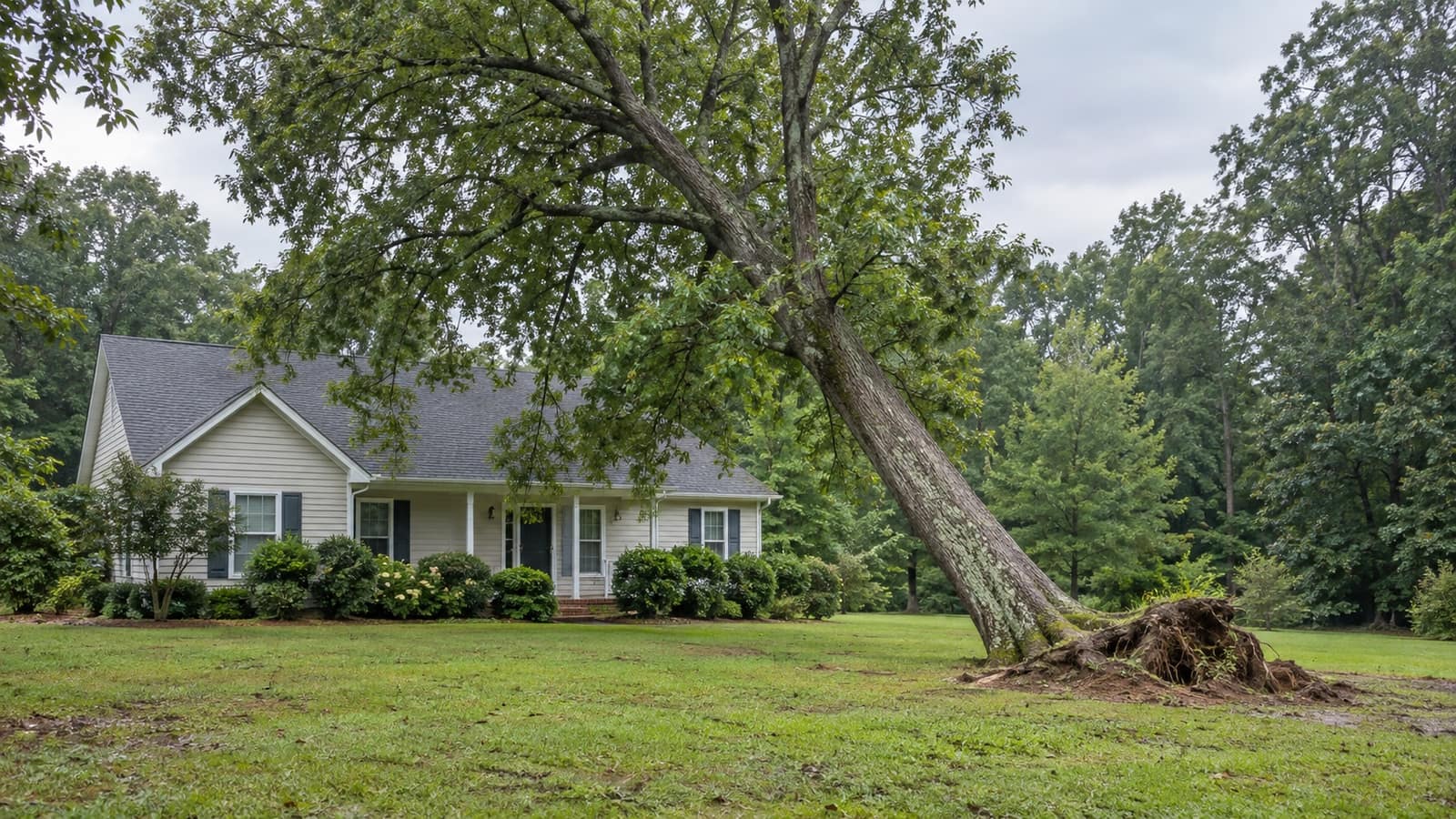
Root condition, soil conditions, wind, tree architecture, health, and age all contribute to whether a tree is likely to withstand severe weather.
If the tree has suddenly changed position, do not stand beneath it, attempt to straighten it, or start cutting roots or branches yourself. Keep people and vehicles away from the area and have it evaluated promptly.
How to Check Whether a Tree Is Still Alive
A bare tree is not necessarily a dead tree.
Deciduous trees normally lose their leaves during dormancy, and some stressed trees may leaf out later than nearby trees in spring. Before deciding that a tree is dead, there are a few simple checks you can make from the ground.
Look at the Buds
During winter and early spring, look closely at several small branches you can safely reach.
Living branches generally have healthy buds appropriate for the species. A dead twig may have shriveled buds, brittle tips, or no viable buds remaining.
Check more than one branch. One dead twig does not tell you the condition of the entire tree.
Check a Small Twig
Living twigs generally retain some flexibility, while dead twigs often become dry and brittle.
Again, use several locations rather than snapping one small branch and deciding the whole tree is dead.
Try a Small Scratch Test
You can also lightly scratch a very small area of bark on a reachable twig.
Green or moist cambium beneath the bark indicates living tissue. Brown, dry tissue suggests that the section you tested is dead. Penn State Extension recommends the scratch test for suspect branches and similarly distinguishes green living tissue from brown, brittle tissue.
If one twig is brown, test another location farther down the branch and then another part of the tree.
A dead twig tells you that twig is dead. It does not tell you that the entire tree is dead.
Do not climb the tree or strip large areas of bark just to perform this test.
Is the Tree Dying, Stressed, Diseased, Dormant, or Dead?
These terms are often used interchangeably, but they describe different situations.
A Stressed Tree
A stressed tree is having difficulty coping with its growing conditions.
Drought, excessive moisture, damaged roots, heat, construction, poor soil, or another environmental problem may temporarily reduce growth and affect the leaves. If the source of stress can be corrected and the tree still has enough healthy tissue, it may recover.
A Diseased Tree
A diseased tree is being affected by a pathogen such as a fungus or bacterium.
Some diseases cause limited leaf spotting and have little long-term effect. Others damage roots, vascular tissues, branches, or structural wood and can eventually contribute to severe decline.
If your tree has unusual leaf spots, cankers, fungal growth, or other signs that point more toward infection, our guide to the signs of a diseased tree covers those symptoms in greater detail.
A Dying or Declining Tree
A dying tree is progressively losing vigor.
The canopy may become thinner, annual growth decreases, branch dieback expands, and the tree has greater difficulty recovering from additional stress. The decline may happen over several growing seasons rather than all at once.
A Dormant Tree
Dormancy is normal.
A deciduous tree without leaves in winter may be completely healthy. Timing, species, bud condition, and the presence of live tissue should all be considered before assuming a leafless tree is dead.
A Dead Tree
A dead tree no longer has living tissue capable of sustaining growth.
The difficult part is that these conditions can overlap. A tree may begin with drought stress, suffer root loss, become more vulnerable to insects or disease, and eventually enter long-term decline.
That is why we look at the history of the tree and property along with the symptoms that are visible today.
What Causes Trees to Die?
Trees can decline for many reasons. Sometimes there is one obvious event, such as a lightning strike or major root damage. More often, several stresses build on one another over time.
Root Damage
A tree's roots absorb water and nutrients, store energy, and provide the structural support that keeps the tree standing.
When a significant portion of the root system is damaged, the rest of the tree eventually has to function with less support.
Common causes include:
- Construction near the tree
- Trenching for utilities
- Cutting roots during landscaping
- Installing driveways or patios
- Heavy vehicles or equipment compacting the soil
- Raising or lowering the soil grade
- Excavation near the trunk
We have seen trees begin losing branches years after work was completed nearby. Nothing looked obviously wrong immediately after construction, but the damaged root system gradually became less able to support the full canopy.
Clemson describes soil compaction, grade changes, and root severing as the three primary causes of tree death associated with construction.
Disease and Fungal Infections
Diseases can attack leaves, branches, bark, vascular tissues, structural wood, and roots.
Some interfere with the movement of water through the tree. Others kill localized areas of tissue or decay the wood that provides structural support.
Possible signs include:
- Branch dieback
- Discolored or spotted leaves
- Cankers
- Bark loss
- Reduced growth
- Root or trunk decay
- Fungal growth
A mushroom in the yard does not automatically mean the tree is diseased. The location of the fungus, the condition of the wood it is growing from, and the other symptoms present on the tree all need to be considered.
Insect Infestations
Insects can be the primary problem, but they frequently take advantage of a tree that is already under stress.
Some insects feed on leaves. Others feed on sap or bore beneath the bark, where their activity can damage the tissues responsible for transporting water and nutrients.
Watch for:
- Small holes in the bark
- Sawdust-like frass around the trunk
- Galleries beneath loose bark
- Sticky residue
- Heavy insect activity
- Damaged leaves
- Branch dieback
- A thinning canopy
For ash trees in particular, emerald ash borer is a local concern. The South Carolina Forestry Commission has confirmed the invasive beetle in multiple Upstate counties, including Oconee, Greenville, Spartanburg, Pickens, and Anderson.
The presence of an insect still does not prove that it started the decline. Native borers and other pests often become more successful after drought, root injury, or another stress has weakened the tree.
Environmental Stress
A tree can decline without any infectious disease or insect infestation.
Possible environmental stresses include:
- Extended drought
- Repeated extreme heat
- Flooding
- Poor drainage
- Saturated soil
- Freeze damage
- Sudden changes in sun exposure
- Chemical or herbicide injury
- Changes in the surrounding soil
Roots require both water and oxygen. Soil that remains saturated for too long can be just as problematic as soil that is too dry.
This is why we do not recommend automatically giving a wilting tree more water without first checking the condition of the soil.
Improper Pruning
Pruning can improve tree structure and remove hazards when it is done correctly. Poor pruning can create additional stress.
Common mistakes include:
- Removing too much canopy at once
- Topping the tree
- Removing large healthy limbs without a clear reason
- Making flush cuts against the trunk
- Leaving long branch stubs
- Damaging the branch collar
- Repeatedly cutting back healthy growth simply to reduce the tree's size
A tree depends on its leaves to produce energy. Removing too much live canopy reduces that capacity, while large or poorly placed wounds can create additional opportunities for decay.
Heavy pruning can also stimulate water sprouts and other rapid replacement growth.
In our experience, homeowners usually prune with good intentions. The problem is that removing more branches does not necessarily solve whatever caused the tree to struggle in the first place.
Storm and Mechanical Damage
Not all storm damage kills a tree immediately.
Wind can split branch unions, tear major limbs away, shift the root plate, or create wounds that remain long after the storm has passed. Lightning can also damage bark and living tissues inside a trunk or branch.
Repeated smaller injuries can add up as well.
Lawnmowers and string trimmers repeatedly striking the base of a tree can damage the bark and living tissue underneath. Once that damage becomes extensive, the tree may have difficulty transporting water and sugars past the injured area.
Poor Planting or the Wrong Growing Site
Some tree problems begin on the day the tree is planted but do not become obvious until years later.
Common issues include:
- Planting the tree too deeply
- Burying the root flare
- Circling or girdling roots
- Leaving too little space for the root system
- Poorly drained soil
- Choosing a species poorly suited to the site
- Piling mulch against the trunk
Clemson recommends keeping the root flare at the soil surface and warns that deep planting and soil piled around the base can contribute to poor growth and gradual decline.
A young tree may tolerate these conditions for some time. The problem becomes more obvious as the tree grows and its demand for water, nutrients, and structural support increases.
Can a Dying Tree Be Saved?
Sometimes.
A declining tree has a better chance of recovering when the problem is identified before extensive portions of the roots, trunk, or canopy have been lost.
A tree may have a reasonable chance of recovery when:
- Most of the canopy remains alive
- New growth is still being produced
- Branch dieback is limited
- Major roots remain intact
- The trunk is structurally sound
- The problem developed recently
- The underlying cause can be corrected
Temporary drought stress, localized pest problems, some diseases, drainage issues, and certain site problems may be manageable when addressed early.
Recovery becomes less likely when there is extensive root loss, major trunk decay, widespread crown death, severe structural defects, or very little remaining growth.
Our process starts by looking at the tree as a whole rather than assuming that an unhealthy-looking tree should automatically be removed. Depending on what we find, the next step may be corrective pruning, changes to the conditions around the tree, continued monitoring, or removal when the tree can no longer be retained safely.
A Tree Can Be Alive and Still Be Unsafe
One of the most important differences to understand is the difference between tree health and tree structure.
A tree can still produce a full crop of green leaves while having a major structural defect.
It may be alive and still have:
- Extensive internal trunk decay
- A major crack between two stems
- Decayed structural roots
- A compromised root plate
- A large hanging branch
- A weak branch union
- Serious storm damage
Clemson recommends inspecting not only a tree's health but also defects in its branches, trunk, and roots when evaluating the possibility of failure.
The reverse can also be true. A tree with scorched or brown leaves after a severe drought may look terrible while remaining structurally stable and capable of recovering.
When we evaluate a tree, we are looking at both questions.
Can the tree continue living?
And separately:
Can it continue standing safely where it is?
Should You Remove a Tree That Is Dying?
A declining tree does not automatically need to be removed.
The decision depends on how much of the tree is affected, whether the underlying cause can be corrected, the condition of its roots and trunk, and what would be damaged if part or all of the tree failed.
A tree standing in an open portion of a large property may be able to remain longer with monitoring than a tree with the same defects beside a house, driveway, road, playground, or frequently used walkway.
Removal becomes more likely when you have a combination of problems such as:
- Extensive crown death
- Major structural-root decay
- A new lean with root-plate movement
- Significant trunk decay
- Large cracks or splitting
- Repeated major branch failures
- Large dead limbs over occupied areas
- A condition that cannot reasonably be corrected
University of Maryland similarly recommends considering both the extent of defects and what could be struck if the tree or a large portion of it fails.
Homeowners generally have more options when a declining tree is assessed early. Waiting until a major limb falls or the root system begins failing can turn a manageable tree-health problem into an emergency removal.
How Long Does a Dying Tree Have Before It Falls?
There is no reliable countdown.
Some trees remain in gradual decline for many years. Others can fail much sooner after severe root loss, major trunk decay, storm damage, or a sudden change in soil conditions.
You cannot determine how long a weakened tree will remain standing simply by looking at how many leaves it still has.
Its stability depends on factors including:
- Root condition
- Trunk strength
- Branch structure
- Soil conditions
- Wind exposure
- Recent weather
- Species and age
- The location and extent of decay
Even healthy trees are not completely wind-proof, and existing structural defects can increase the likelihood of failure during severe weather.
If the tree has developed a sudden lean, fresh root-plate movement, a major trunk split, or a large hanging branch, do not wait for the rest of the canopy to decline before having it inspected.
Is Your Tree Dying? Have It Inspected
You do not need to wait until a tree is completely bare or a major branch has already fallen to find out what is going on.
When we inspect a declining tree, we look at the canopy, branches, trunk, root flare, visible roots, and the conditions around it. We also want to know when the symptoms began and whether anything changed around the property before the decline became noticeable.
Sometimes the right answer is to give the tree more time and monitor it. Sometimes pruning or correcting another problem can help. And when the roots, trunk, or major branches have deteriorated to the point that the tree is no longer safe, removal may be the better option.
Palmetto Tree Pros provides tree health inspections, pruning, and tree removal throughout Seneca, Westminster, Walhalla, Liberty, and surrounding Upstate South Carolina communities. The company offers free on-site estimates and is licensed and insured.
Contact Palmetto Tree Pros or call or text (864) 364-4362 to have a declining or potentially hazardous tree evaluated.
Need a hand with your trees?
We offer free, on-site estimates across Seneca and the Upstate. Call or request a quote and we'll come take a look.