Who Is Responsible for Cutting Overhanging Tree Branches in South Carolina?
A tree can be healthy and well-maintained and still cause problems once its branches extend across a property line.
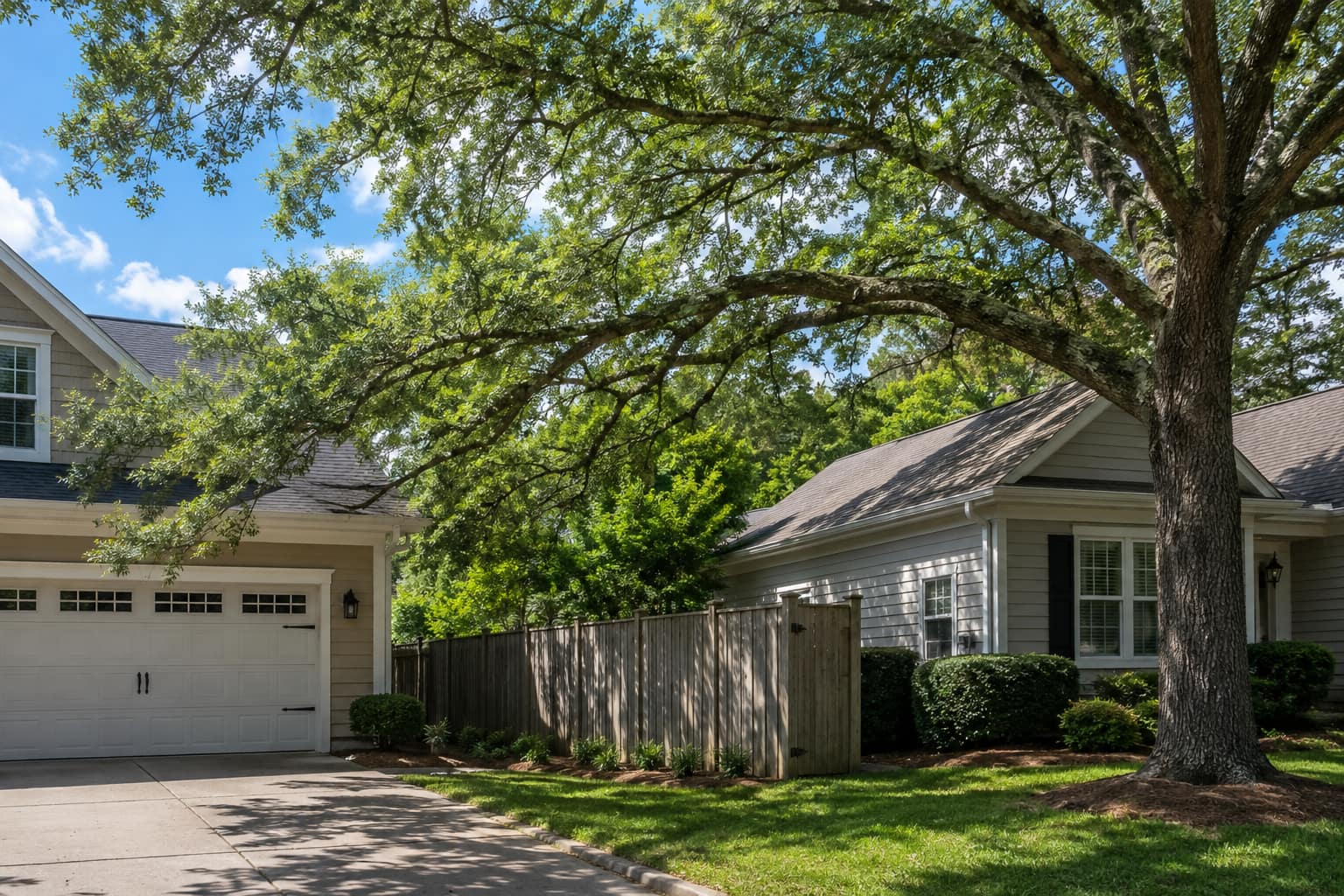
In some situations, the trunk may stand entirely on one property while the canopy extends over a neighboring fence, roof, driveway, or yard, but tree ownership does not always determine who must arrange or pay for the pruning.
The tree owner may not be required to cut the branches back, while the neighboring property owner cannot necessarily remove them without considering the property line, local restrictions, and the potential impact on the tree.
Responsibility can become even more complicated if an overhanging branch falls and damages a roof, fence, vehicle, or another part of the neighboring property. Pruning the wrong limbs or removing too much canopy can also weaken the tree, compromise its stability, and create an entirely new dispute between property owners.
In this article, we'll walk you through who is responsible for cutting overhanging branches in South Carolina, what you are and are not allowed to trim, when the tree owner may become responsible, and how to handle the problem without creating a safety hazard or a dispute with your neighbor.
Property Lines and Tree Ownership in South Carolina
Before deciding what to do with an overhanging branch, start by determining where the tree and the property line actually are.
If the trunk is clearly located within your neighbor's property, you should treat the tree as your neighbor's tree. Branches extending above your yard do not give you ownership of the trunk or permission to enter the neighboring property to perform work.
The situation becomes less straightforward when the trunk grows directly on or very close to the boundary. Fences, mowing lines, hedges, and landscaping do not always follow the legal property line, so a survey may be necessary before major work.
This is particularly important if the proposed pruning requires access to the neighboring property, involves a large portion of the canopy, or could affect the tree's health or stability.
A property boundary can also contain a formal survey monument. South Carolina's current §16-11-680 prohibits maliciously or fraudulently moving, altering, destroying, or removing geodetic control monuments and property-corner monuments, and the statutory definition recognizes that a tree, stump, stake, or mark on a tree can sometimes serve as such a monument.
If you are unsure where the legal boundary lies, confirm it before cutting.
Can You Cut Your Neighbor's Overhanging Branches in South Carolina?
South Carolina’s current §16-11-520 makes it unlawful to willfully and maliciously cut, mutilate, deface, or otherwise injure another person's tree or commit a trespass on another person's property.
The current statute does not contain a specific exception authorizing the trimming of limbs simply because they extend across a property line.
South Carolina lawmakers have considered adding exactly that exception. House Bill 3624 would amend §16-11-520 so that the section would not apply to someone trimming limbs that encroach upon their property line.
The General Assembly's official history still shows the bill as introduced and referred to the House Judiciary Committee, rather than enacted into law.
South Carolina appellate courts also have not clearly established the broad self-help rule used in many other states.
That does not mean every homeowner who clips a small branch hanging across the fence is committing a crime.
Section 16-11-520 itself contains requirements such as willful and malicious conduct. It does mean that homeowners should be cautious about assuming South Carolina gives them an unrestricted legal right to substantially prune someone else's tree.
For a few small branches where both homeowners agree on the work, there may be little practical dispute. When large limbs are involved, however, talk with the tree owner before pruning and get permission if the proper cuts require work beyond your property.
Fruit can create a similar question when a fruit-bearing branch extends across the property line. South Carolina law does not clearly spell out who may pick fruit hanging from a neighbor’s tree, so we would not assume that the branch being above your yard automatically gives you the right to harvest it.
If you want the fruit, ask the tree owner first. That is especially important if picking it requires pulling on, climbing, cutting, or otherwise altering the branch.
Who Pays to Cut Overhanging Tree Branches?
South Carolina has no statewide rule that makes a tree owner automatically responsible for paying to prune every healthy branch that grows over a neighboring property.
If the tree is healthy and the branches are simply creating shade, dropping leaves, extending over a driveway, or taking up space in the neighboring yard, the homeowners may need to work out who wants the pruning performed and who will pay for it.
In practice, the person requesting additional clearance may pay for routine pruning, or the neighbors may agree to split the cost when proper pruning benefits both properties.
The situation can change when the branch is not merely inconvenient but appears to be hazardous.
A dead branch hanging above a roof is different from a healthy branch providing unwanted shade. A large cracked limb above a driveway is different from a few healthy twigs extending across a fence.
South Carolina courts have recognized a duty of reasonable care for urban landowners to inspect trees on their property and make sure they are safe. In Israel v. Carolina Bar-B-Que, discussed by the Court of Appeals in Underwood v. Coponen, liability arose where evidence showed a fallen limb was partially decayed and the condition could have been discovered through reasonable inspection.
That does not make a tree owner responsible every time a branch crosses a property line. The tree's condition and whether there was a reasonably discoverable hazard matter more.
What About Tree Roots Crossing the Property Line?
Branches are not the only part of a tree that can cross a property line. Roots may extend beneath fences, driveways, patios, retaining walls, and other parts of a neighboring property, sometimes becoming noticeable only after concrete begins to lift or an underground line develops a problem.
The same caution we recommend with overhanging branches applies to roots. South Carolina does not currently have a statewide statute that clearly gives a homeowner an unrestricted right to cut a neighbor’s roots simply because they have crossed the property line. State law also prohibits willfully and maliciously injuring another person’s tree.
Roots introduce another concern as well. Large roots near the trunk may provide a significant amount of the tree’s structural support. Severing one or several of them can weaken the tree, cause decline, or make it less stable during strong winds. If the tree later falls toward a home, vehicle, fence, or another property, cutting the roots may have created a much larger problem than the one you were trying to solve.
When we inspect a root conflict, we look at the size of the roots, their distance from the trunk, what they are affecting, the condition of the tree, and how much of the root system could be disturbed without compromising its stability.
If neighboring tree roots are lifting a driveway, patio, walkway, or retaining wall, or appear to be affecting a foundation or underground line, have the situation evaluated before cutting them. Depending on the property, the better solution may involve selective root pruning, changing the hardscape, repairing a damaged pipe or drainage problem, installing a root barrier where appropriate, or removing the tree when the necessary root cuts would leave it unsafe.
When an Overhanging Branch Becomes a Safety Concern
A healthy limb extending into another yard does not necessarily require immediate pruning.
We become more concerned when the branch shows signs that its strength or attachment may be compromised.
When we inspect an overhanging limb, we look for conditions such as:
- A large branch with no foliage during the growing season
- A visible split or crack where the limb joins the trunk
- Missing or peeling bark around the attachment
- A cavity or decayed section in a major limb
- Mushrooms or fungal growth on the trunk or branch
- A partially broken branch hanging in the canopy
- Previous limb failures from the same tree
- Included bark or a weak union between large stems
- Storm damage that has left a limb fractured or hanging
- Major changes in the tree's lean or root stability
One of these signs does not automatically mean the branch will fail. The size of the limb, the extent of decay, the way it is attached, wind exposure, the condition of the rest of the tree, and what is beneath the branch all affect the level of risk.
A branch hanging over an unused corner of a yard presents a different situation from the same branch hanging above a bedroom, driveway, sidewalk, or children's play area.
If you are concerned about a branch from a neighboring tree, let the owner know what you are seeing.
For a significant defect, take photographs and consider having the tree professionally assessed before the condition gets worse.
What if the Tree Owner Has Been Warned About a Dangerous Branch?
Prior notice can become important when an obviously defective tree or limb later causes damage.
South Carolina case law recognizes that urban property owners have a duty of reasonable care regarding defective or unsound trees.
If you believe a neighboring limb presents a serious hazard, document the concern rather than relying only on a verbal conversation.
You may want to keep:
- Dated photographs of the branch
- Written messages or emails to the neighbor
- A professional tree assessment
- Previous photographs showing deterioration
- Records of earlier branch failures
- Estimates recommending pruning or removal
Written notice does not automatically make the neighbor legally responsible if something happens later. It can, however, help establish when the concern was raised and give the tree owner an opportunity to have the condition evaluated.
As a tree company, our role is to assess the tree and recommend appropriate work.
We can document visible decay, cracks, deadwood, weak attachments, and other concerns, but legal liability is ultimately a question for insurers, attorneys, or the courts.
What if an Overhanging Branch Falls and Causes Damage?
Once a branch falls, the fact that it came from your neighbor's tree does not automatically determine whose insurance pays.
The South Carolina Department of Insurance gives the example of a neighbor's tree falling during a storm and damaging a fence. It states that the damaged homeowner's own policy should generally cover the loss.
The homeowner's insurer may then attempt to recover what it paid, including the deductible, from the neighbor's insurer if the loss resulted from the neighbor's negligence.
The condition of the branch before it fell can therefore become important.
When a Healthy Branch Falls During a Storm
High winds and severe storms can break healthy limbs without any reasonable warning.
South Carolina's Department of Insurance says most homeowners policies cover damage to the dwelling and other insured structures caused by wind, subject to the policy's terms and deductible.
If an apparently healthy neighboring branch falls during a storm, contact your own insurer first and document the damage.
When the Branch Was Already Dead or Defective
A different question arises when the branch was dead, visibly decayed, badly cracked, or otherwise unsafe before it fell.
South Carolina courts have held that an urban landowner's duty of reasonable care extends to defective or unsound trees and have recognized liability where a dangerous condition could have been discovered through reasonable inspection.
Whether that standard is met in a particular case depends on the facts. A single dead twig is not the same as a large decayed limb hanging above a neighbor's house, and the presence of a defect does not automatically establish negligence.
If a branch causes damage, photograph the branch, the point where it failed, the tree, and the damaged property before cleanup begins whenever it is safe to do so.
What Happens if You Damage Your Neighbor's Tree While Pruning?
A branch over your property doesn't make poor pruning harmless.
Removing a few small limbs and removing half of a mature tree's canopy are completely different jobs. Large cuts can change the tree's weight distribution, reduce the amount of foliage available for photosynthesis, open large wounds to decay, and leave the tree structurally compromised.
When we look at a large overhanging limb, we are not only looking at where the property line crosses beneath it. We look at where the branch attaches, its size and weight, how much live canopy would be removed, what the correct pruning point would be, and how the rest of the tree will respond afterward.
Sometimes the proper pruning cut is on the tree owner's side of the property line. Cutting the limb exactly at the boundary could leave a long stub rather than making the cut at an appropriate branch union. In that situation, talking with the owner and obtaining permission may allow the job to be completed in a way that is better for the tree.
South Carolina law also creates potential consequences for intentionally injuring another person's tree. Section 16-11-520 establishes criminal penalties for willful and malicious injury based on the value of the property loss.
Section 16-11-615 also provides a mechanism involving damages of up to three times the fair-market value of timber in certain prosecutions and civil actions involving the statutes it covers.
The exact application of these statutes depends on the circumstances, so they should not be read to mean an accidental bad pruning cut automatically results in criminal or treble liability.
What if the Tree Is Directly on the Property Line?
A tree growing directly along the legal boundary deserves extra caution.
First, confirm that the trunk actually crosses the property line. A fence is not necessarily the legal boundary, and trees often outlive fences, surveys, and previous owners.
If ownership is uncertain, do not remove the tree or perform major structural pruning until the boundary has been confirmed and the people involved have agreed on the work.
Also be careful around survey markers. Since the 2024 amendment to §16-11-680, South Carolina law specifically protects geodetic and property-corner monuments from malicious or fraudulent alteration or removal, and those monuments can include trees, stumps, stakes, or marks on trees when they have been established as part of a survey.
For a mature tree directly on the boundary, getting written agreement before major pruning or removal can prevent later disputes about what was authorized and who agreed to pay.
What if Overhanging Branches Are Touching Your Roof?
A branch does not automatically need to be removed simply because it grows above a house.
When we inspect branches near a structure, we look at the amount of clearance, whether the limb is healthy, how it moves in the wind, its weight and attachment, and what part of the structure it could strike if it failed.
Pruning may be appropriate when branches:
- Rub directly against shingles, siding, or gutters
- Strike the roof during ordinary winds
- Hang over a chimney
- Are dead, cracked, or storm-damaged
- Have an obviously weak attachment
- Block necessary access to the roof
- Extend into electrical lines
- Present a significant hazard to the structure below
The goal is not necessarily to strip every limb away from the house. Excessive pruning can create large wounds, remove too much foliage, and leave a mature tree poorly balanced.
Good pruning creates the needed clearance while preserving as much healthy structure as possible.
What About Branches Near Power Lines?
Do not attempt to prune a branch simply because it crosses onto your property if it is close to an electrical line.
Electricity can arc through the air, and the branch itself, a pole saw, climbing equipment, or another tool can create a path to the line.
Duke Energy states that only qualified professionals should prune around power lines and directs customers to report vegetation that interferes with or threatens electrical equipment.
Utility vegetation crews may maintain trees around distribution lines and utility rights-of-way.
Responsibilities can differ for vegetation near the service line running to an individual home, so contact the utility before arranging work when electrical lines are involved.
Do not use a ladder, pole saw, or chainsaw near an energized line.
How to Handle an Overhanging Tree Dispute With Your Neighbor
Most branch problems are easier to resolve before anyone starts cutting.
Begin by showing the neighbor what is bothering you. A dead limb or crack may be obvious from your yard and difficult to see from theirs.
If pruning is appropriate, discuss:
- Which branches need to be removed
- Where the cuts should be made
- Whether workers need access to both properties
- Who will hire the tree service
- Who will pay for the work
- What will happen to the branches and debris afterward
For larger jobs, photographs and a written estimate can make the scope much clearer.
If you believe the tree is hazardous and the owner disagrees, have a professional assess the condition and send your concerns in writing. Keep copies of the photographs, assessment, and communication.
HOA covenants and local ordinances can create additional requirements for protected trees, street trees, trees in rights-of-way, or trees that are part of an approved landscape plan. Check those rules before performing substantial pruning or removal.
Local requirements can add another layer even when both property owners agree on the tree work. South Carolina does not have one statewide tree-removal threshold, and individual cities and towns can establish their own requirements for protected trees, significant trees, street trees, and trees that are part of an approved development or landscape plan.
For example, the City of Greenville requires a Tree Disturbance Form before trees are removed from properties within formal city limits. Summerville uses a different system and currently requires a removal permit for trees measuring eight inches or more in diameter at breast height, including dead trees.
Pruning and removal are not necessarily regulated in the same way, so check the rules for the property before substantially altering or removing a large tree. HOA approval may also be separate from any city or county requirement.
For a serious property-rights or liability dispute, speak with a South Carolina attorney rather than relying on general tree-law information online.
When Should You Hire a Tree Service to Cut Overhanging Branches?
Small branches that are easily accessible are very different from a mature limb hanging above a house.
Consider professional tree work when:
- The limb is large or heavy
- The branches are high in the canopy
- The work would require climbing
- The limb extends over a roof, fence, driveway, or vehicle
- The tree has visible decay, cracking, or storm damage
- A branch is broken and hanging
- The tree has been heavily pruned on one side already
- You are unsure where the proper pruning cut should be
- The work is close to the property line
- Removing the branch could affect the tree's balance
- The tree is near electrical lines
- There is already a disagreement between the property owners
In our experience, some of the most difficult pruning jobs are not the trees with obviously dead limbs. They are healthy mature trees where a homeowner wants a large amount of clearance but removing everything requested would leave the tree poorly balanced or require improper cuts.
A professional tree service can assess the entire tree, not just the portion crossing the fence. That allows the pruning plan to account for the limb's attachment, the remaining canopy, potential targets below, and how the tree will respond after the cut.
Need Help With Overhanging Tree Branches?
An overhanging branch does not always need to be removed, and when pruning is necessary, where and how the cut is made can affect the tree for years.
At Palmetto Tree Pros, we can inspect the tree, identify dead or hazardous limbs, determine whether the requested pruning can be completed without unnecessarily damaging the canopy, and develop a safe approach for branches hanging over roofs, driveways, fences, and other structures.
Palmetto Tree Pros is a family-owned, licensed and insured tree service serving Seneca, Westminster, Walhalla, Liberty, Clemson, Central, and surrounding Upstate South Carolina communities. Free on-site estimates are available.
Contact Palmetto Tree Pros or call or text (864) 364-4362 to have an overhanging or hazardous branch evaluated.
Need a hand with your trees?
We offer free, on-site estimates across Seneca and the Upstate. Call or request a quote and we'll come take a look.